

Vacuum Pumps And Accessories
The two most frequent questions service technicians ask about dehydration are:
To give specific answers to these questions, you need to know the cubic capacity of the system to be dehydrated; amount of moisture both visible and invisible present in the system; I.D. and length of the connecting line as well as the restrictions within the system itself (cap tubes, valves, etc.) which might cause back pressures.
Change Your Vacuum Pump Oil Frequently Clean oil is important for peak vacuum pump performance. When the oil is contaminated, it reduces your pump’s ability to remove moisture from a system. You should change the pump oil frequently, and especially in the following situations:
|  |
Premium High Vacuum Pump Oil
The performance of your pump depends largely on the quality and purity of the vacuum pump oil. Robinair’s oil is engineered to maintain maximum viscosity at high running temperatures and to improve cold weather starts.
To keep the pump operating at peak efficiency, change the oil frequently. Moisture and other contaminants can quickly deteriorate the purity of the oil, thinning the oil, and reducing the pump’s ability to reach deep vacuum conditions.
Thermally Stable
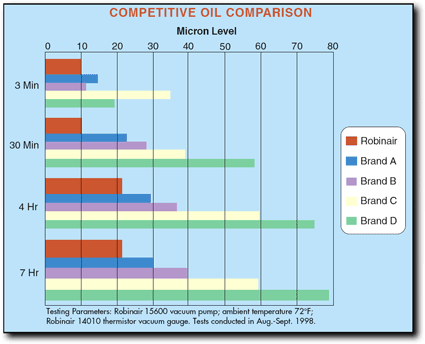
Laboratory tests prove that Robinair oil is more thermally stable in comparison to other leading brands, which means it resists breaking down due to heat for a longer period of time.
Lower Moisture Content
Robinair oil has a lower moisture content than other oils, thanks to our special packaging and handling procedures. Moisture degrades the oil’s purity, thinning it, and reducing the pump’s ability to reach a deep vacuum.