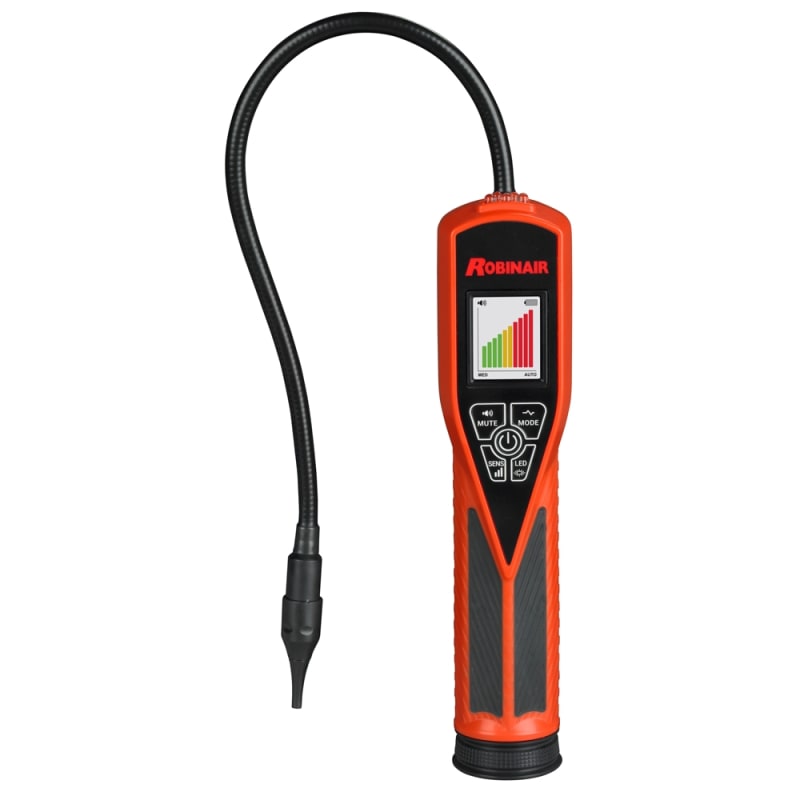
The LD9-TG Robinair Hydrogen Tracer Gas Leak Detector. The LD9-TG features sensor technology designed to detect a 5%hydrogen / 95% nitrogen tracer gas mixture. The LD9-TG’s full color liquid crystal display (LCD) and sweep mode function convey messages, graphics, and prompts to help the A/C technician locate the source of a leak and ensure that the leak detector is always at optimal performance. The light-emitting diode (LED) inspection lights aid thetechnician in locating and inspecting suspected leak sources. When used with the hydrogen/nitrogen tracer gas mixture, the LD9-TG will detect leak rates equivalent to 4 g/year of R-134a in the High setting, and 7 g/year in the Normal setting while moving at 3 inches (8 cm) per second. This complies with SAE J2970 sections 7.2 and 7.3. Testing with tracer gas also complies with European standards EN 35422 and EN 14624.
The UV wavelength technology is used with tracer gas instead of liquid refrigerant to locate system leaks. The LD9-TG is compatible with most hydrogen-based tracer gases. 10-year sensor life. A patented 3 LED inspection light aids in locating and inspecting suspected leak sources.
- Using tracer gas eliminates the need to use expensive refrigerant to find leaks. Filling a system with tracer gas is fast and effective, with a much lower cost than refrigerant.
- Detects leaks as small as 0.5 ounces/year for R134a and .015 ounces/year for R1234yf.
- The kit includes the LD9 tracer gas leak detector, 134a and 1234yf high and low side couplers, hose and regulator for tracer gas.
- Meets SAE J2970 industry standards. Tracer gas not included.
- Tracer gas sold separately. Meets SAE J2970 industry standards.
Sweep (Pinpoint) Mode
This mode allows the user to “zero in” or pinpoint hard to find small leaks.
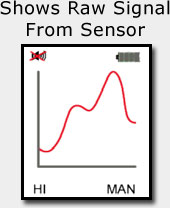
Similar to an oscilloscope trace “sweeping” across the display, the display “cursor” will sweep across the display from left to right tracking a horizontal baseline over a 3 second period.
When no leak is sensed, the baseline trace will be flat. While searching, if refrigerant gas is sensed, the horizontal trace on the display will rise up and continue to rise as the leak source is approached. If the user moves away from the leak source, the trace will drop back down.
Because the display in this mode is based on a time period, the previous leak level sensed will be displayed helping the user to determine where the maximum level of gas is present- thereby pinpointing the source of the leak. | ![]() |


 Warning: This product may expose you to chemicals including lead which are known to the State of California to cause cancer and birth defects or other reproductive harm. For more information go to www.P65Warnings.ca.gov